Thomas Paine Start the World Again
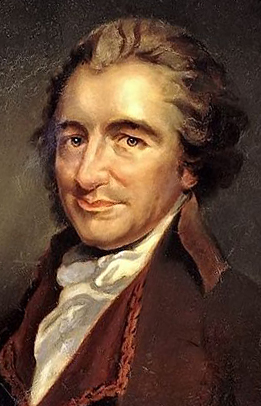
British-American author of The Age of Reason, Common Sense, Rights of Man and Crisis, Thomas Paine (1737/01/29 - 1809/06/08) has not been proven to accept been a freemason. A brilliant pamphleteer, his theory most the origins of Freemasonry is only of interest equally an historical curiosity.
Thomas Paine'southward
Origin of Free-Masonry
IT is e'er understood that Free-Masons have a hugger-mugger which they advisedly muffle; but from every thing that tin can exist collected from their own accounts of Masonry, their existent undercover is no other than their origin, which but few of them understand; and those who do, envelope it in mystery. The Society of Masons are distinguished into three classes or degrees. 1st. The Entered Apprentice. 2d. The Young man Arts and crafts. 3d. The Principal Stonemason. The Entered Amateur knows but footling more of Masonry than the use of signs and tokens, and certain steps and words by which Masons can recognize each other without being discovered by a person who is not a Mason. The Beau Arts and crafts is not much ameliorate instructed in Masonry, than the Entered Amateur. It is only in the Main Mason's Society, that whatever noesis remains of the origin of Masonry is preserved and curtained. In 1730, Samuel Pritchard, member of a constituted lodge in England, published a treatise entitled Masonry Dissected; and fabricated oath before the Lord Mayor of London that it was a true copy. "Samuel Pritchard maketh oath that the copy hereunto annexed is a true and genuine copy in every particular." In his work he has given the catechism or test, in question and answer, of the Apprentices, the Boyfriend Craft, and the Master Mason. At that place was no difficulty in doing this, as it is mere form. In his introduction he says, the original institution of Masonry consisted in the foundation of the liberal arts and sciences, but more than especially in Geometry, for at the building of the belfry of Babel, the fine art and mystery of Masonry was first introduced, and from thence handed down by Euclid, a worthy and excellent mathematician of the Egyptians; and he communicated it to Hiram, the Chief Mason concerned in building Solomon's Temple in Jerusalem." As well the absurdity of deriving Masonry from the edifice of Boom-boom, where, according to the story, the confusion of languages prevented the builders agreement each other, and consequently of communicating any cognition they had, there is a glaring contradiction in indicate of chronology in the account he gives. Solomon's Temple was congenital and dedicated 1004 years before the christian era; and Euclid, as may be seen in the tables of chronology, lived 277 earlier the aforementioned era. It was therefore impossible that Euclid could communicate any matter to Hiram, since Euclid did not live till 700 years subsequently the time of Hiram. In 1783, Captain George Smith, inspector of the Royal Artillery Academy at Woolwich, in England, and Provincial Grand Master of Masonry for the county of Kent, published a treatise entitled, The Use and Abuse of Gratis-Masonry. In his chapter of the antiquity of Masonry, he makes it to be coeval with creation, "when," says he, "the sovereign builder raised on Masonic principles the admirable world, and commanded the master scientific discipline, Geometry, to lay the planetary earth, and to regulate past its laws the whole stupendous system in just unerring proportion, rolling round the key sun." "Simply," continues he, "I am non at liberty publicly to undraw the curtain, and openly to descant on this head; information technology is sacred, and always will remain so; those who are honored with the trust will not reveal it, and those who are ignorant of it cannot betray it." Past this last role of the phrase, Smith means the two inferior classes, the Fellow Craft and the Entered Apprentice, for he says in the next page of his work, "It is non every one that is barely initiated into Gratis-Masonry that is entrusted with all the mysteries thereto belonging; they are not attainable as things of course, nor past every capacity." The learned, but unfortunate Doctor Dodd, One thousand Chaplain of Masonry, in his oration at the dedication of Free-Mason's Hall, London, traces Masonry through a variety of stages. Masons, says he, are well informed from their ain private and interior records that the edifice of Solomon's Temple is an important era, from whence they derive many mysteries of their fine art. "Now (says he,) be it remembered that this great issue took place above thousand years before the Christian era, and consequently more a century before Homer, the first of the Grecian Poets, wrote; and above five centuries before Pythagoras brought from the east his sublime system of truly masonic instruction to illuminate our western world. But, remote as this period is, we date not from thence the commencement of our art. For though it might owe to the wise and glorious Rex of Israel some of its many mystic forms and hieroglyphic ceremonies, yet certainly the art itself is coeval with man, the great subject of it. "We trace," continues he, "its footsteps in the well-nigh distant, the most remote ages and nations of the world. We find information technology amid the commencement and most celebrated civilizers of the East. Nosotros deduce information technology regularly from the first astronomers on the plains of Chaldea, to the wise and mystic kings and priests of Arab republic of egypt, the sages of Greece, and the philosophers of Rome." From these reports and declarations of Masons of the highest gild in the institution, we come across that Masonry, without publicly declaring so, lays merits to some divine communication from the creator, in a manner different from, and unconnected with, the book which the christians call the bible; and the natural issue from this is, that Masonry is derived from some very ancient religion, wholly independent of and unconnected with that book. To come and so at in one case to the indicate, Masonry (every bit I shall evidence from the customs, ceremonies, hieroglyphics, and chronology of Masonry) is derived and is the remains of the organized religion of the ancient Druids; who, similar the Magi of Persia and the Priests of Heliopolis in Arab republic of egypt, were Priests of the Lord's day. They paid worship to this groovy luminary, as the great visible agent of a great invisible first cause whom they styled " Time without limits." [NOTE: Zarvan-Akarana. This personification of Boundless Time, though a part of Parsee Theology, seems to be a subsequently monotheistic dogma, based on perversions of the Zendavesta. See Haug's "Religion of the Parsees." — Editor.] The christian religion and Masonry have ane and the same common origin: both are derived from the worship of the Sun. The divergence betwixt their origin is, that the christian religion is a parody on the worship of the Sunday, in which they put a man whom they call Christ, in the place of the Sun, and pay him the same admiration which was originally paid to the Sun, as I have shown in the affiliate on the origin of the Christian religion. [NOTE: Referring to an unpublished portion of the work of which this chapter forms a part. — American Editor, 1819 [This paragraph is omitted from the pamphlet copyrighted by Madame Bonneville in 1810, as also is the concluding sentence of the next paragraph. — Editor.] In Masonry many of the ceremonies of the Druids are preserved in their original state, at least without whatsoever parody. With them the Sun is still the Lord's day; and his image, in the form of the sun is the slap-up emblematical ornament of Masonic Lodges and Masonic dresses. It is the central figure on their aprons, and they vesture information technology also pendant on the breast in their lodges, and in their processions. It has the figure of a human being, as at the head of the sun, as Christ is ever represented. At what menstruum of antiquity, or in what nation, this religion was start established, is lost in the labyrinth of unrecorded time. It is generally ascribed to the ancient Egyptians, the Babylonians and Chaldeans, and reduced later on to a organisation regulated by the apparent progress of the sun through the twelve signs of Zodiac by Zoroaster the police giver of Persia, from whence Pythagoras brought it into Greece. It is to these matters Dr. Dodd refers in the passage already quoted from his oration. The worship of the Sun equally the keen visible agent of a dandy invisible beginning cause, "Time without limits," spread itself over a considerable part of Asia and Africa, from thence to Greece and Rome, through all aboriginal Gaul, and into Britain and Republic of ireland. Smith, in his affiliate on the artifact of Masonry in United kingdom, says, that "notwithstanding the obscurity which envelopes Masonic history in that country, various circumstances contribute to prove that Free-Masonry was introduced into Uk near 1030 Years before Christ." It cannot exist Masonry in its present state that Smith hither alludes to. The Druids flourished in Britain at the menses he speaks of, and it is from them that Masonry is descended. Smith has put the child in the place of the parent. It sometimes happens, as well in writing as in conversation, that a person lets slip an expression that serves to unravel what he intends to conceal, and this is the case with Smith, for in the same affiliate he says, "The Druids, when they committed whatsoever matter to writing, used the Greek alphabet, and I am bold to affirm that the most perfect remains of the Druids' rites and ceremonies are preserved in the customs and ceremonies of the Masons that are to be found existing among flesh." "My brethren" says he, "may be able to trace them with greater exactness than I am at liberty to explicate to the public." This is a confession from a Principal Mason, without intending information technology to be then understood by the public, that Masonry is the remains of the religion of the Druids; the reasons for the Masons keeping this a secret I shall explicate in the course of this work. As the study and contemplation of the Creator [is] in the works of the cosmos, the Sun, equally the bang-up visible agent of that Beingness, was the visible object of the admiration of Druids; all their religious rites and ceremonies had reference to the credible progress of the Sun through the twelve signs of the Zodiac, and his influence upon the globe. The Masons adopt the same practices. The roof of their Temples or Lodges is ornamented with a Sun, and the floor is a representation of the variegated face of the earth either past carpeting or Mosaic piece of work. Free Masons Hall, in Neat Queen-street, Lincoln's Inn Fields, London, is a magnificent building, and cost upward of 12,000 pounds sterling. Smith, in speaking of this building, says (page 152,) "The roof of this magnificent Hall is in all probability the highest piece of finished architecture in Europe. In the middle of this roof, a most resplendent Sun is represented in burnished gold, surrounded with the twelve signs of the Zodiac, with their respective characters; After giving this description, he says, "The emblematical pregnant of the Sun is well known to the enlightened and inquisitive Gratis-Mason; and equally the real Sun is situated in the centre of the universe, so the emblematical Dominicus is the centre of existent Masonry. We all know (continues he) that the Sun is the fountain of lite, the source of the seasons, the cause of the vicissitudes of day and night, the parent of vegetation, the friend of man; hence the scientific Gratuitous-Mason simply knows the reason why the Sun is placed in the center of this beautiful hall." The Masons, in order to protect themselves from the persecution of the christian church building, have always spoken in a mystical manner of the effigy of the Sun in their Lodges, or, like the astronomer Lalande, who is a Mason, been silent upon the subject field. It is their secret, specially in Catholic countries, because the figure of the Sun is the expressive criterion that denotes they are descended from the Druids, and that wise, elegant, philosophical organized religion, was the religion contrary to the faith of the gloomy Christian church building. [Notation: This judgement is omitted in Madame Bonneville'southward publication. — Editor.] The Lodges of the Masons, if built for the purpose, are constructed in a fashion to represent with the apparent move of the Sun. They are situated Eastward and West. [NOTE: The Freemason's Hall in London, which Paine has correctly described, is situated North and S, the exigencies of the space having been too strong for Masonic orthodoxy. Though nominally due east the Master stands at the Due south. — Editor.] The master's place is ever in the East. In the examination of an Entered Apprentice, the Master, amid many other questions, asks him, Q: How is the lodge situated? 
Annotation: This essay appeared in New York, 1818, with an anonymous preface of which I quote the opening paragraph: "This tract is a chapter belonging to the 3rd Role of the Age of Reason, as will be seen by the references made in it to preceding articles, as forming role of the same work. It was culled from the writings of Mr. Paine after his death, and published in a mutilated state by Mrs. Bonneville, his executrix. Passages having a reference to the Christian religion she erased, with a view no doubt of all-around the work to the prejudices of bigotry. These, however, have been restored from the original manuscript, except a few lines which were rendered illegible." Madame Bonneville published this fragment in New York, 1810 (with the omissions I betoken out) every bit a pamphlet. — Dr. Robinet (Danton - Emigre, p. 7) says erroneously that Paine was a Freemason; only an eminent member of that Fraternity in London, Mr. George Briggs, later on reading this essay, which I submitted to him, tells me that "his general outline, remarks, and comments, are adequately truthful." Paine's intimacy in Paris with Nicolas de Bonneville and Charles Frangois Dupuis, whose writings are replete with masonic speculations, sufficiently explicate his involvement in the subject. — Moncure Daniel Conway The Writings of Thomas Paine 1896 K.P. Putnam's Sons, New York.
A: East and West.
Q: Why so?
A: Because all churches and chapels are, or ought to be so. This reply, which is mere catechismal form, is non an answer to the question. Information technology does no more than remove the question a indicate further, which is, why ought all churches and chapels to be so? But every bit the Entered Amateur is not initiated into the druidical mysteries of Masonry, he is not asked any questions a straight respond to which would lead thereto. Q: Where stands your Master?
A: In the Eastward.
Q: Why so?
A: As the Dominicus rises in the Due east and opens the 24-hour interval, so the Principal stands in the East, (with his right hand upon his left chest, being a sign, and the foursquare about his neck,) to open the Lodge, and prepare his men at work. Q: Where stand your Wardens?
A: In the W.
Q: What is their business?
A: As the Sun sets in the West to close the day, so the Wardens stand in the Due west, (with their correct easily upon their left breasts, being a sign, and the level and plumb rule about their necks,) to shut the Club, and dismiss the men from labor, paying them their wages. Here the proper name of the Sun is mentioned, only it is proper to observe that in this place it has reference but to labor or to the time of labor, and not to any religious druidical rite or anniversary, equally it would have with respect to the situation of Lodges East and West. I have already observed in the chapter on the origin of the christian religion, that the state of affairs of churches E and Westward is taken from the worship of the Sunday, which rises in the east, and has not the least reference to the person called Jesus Christ. The christians never bury their dead on the North side of a church building; [Annotation: In many parts of Northern Europe the N was supposed to be the region of demons. Executed criminals were buried on the north side of churches. — Editor.] and a Mason's Lodge always has, or is supposed to accept, three windows which are called fixed lights, to distinguish them from the moveable lights of the Sun and the Moon. The Chief asks the Entered Apprentice, Q: How are they (the fixed lights) situated?
A: East, West, and South.
Q: What are their uses?
A: To light the men to and from their work.
Q: Why are there no lights in the North?
A: Because the Sun darts no rays from thence. This, among numerous other instances, shows that the christian religion and Masonry accept ane and the same common origin, the ancient worship of the Lord's day. The high festival of the Masons is on the day they telephone call St. John's day; but every aware Mason must know that holding their festival on this day has no reference to the person called St. John, and that it is just to disguise the truthful cause of holding it on this day, that they call the 24-hour interval by that proper name. As in that location were Masons, or at least Druids, many centuries before the time of St. John, if such person ever existed, the holding their festival on this day must refer to some cause totally unconnected with John. The case is, that the 24-hour interval called St. John's twenty-four hour period, is the 24th of June, and is what is called Midsummer-solar day. The lord's day is and then arrived at the summertime solstice; and, with respect to his meridional altitude, or top at high noon, appears for some days to be of the same tiptop. The astronomical longest day, like the shortest solar day, is not every year, on account of leap year, on the same numerical twenty-four hours, and therefore the 24th of June is always taken for Midsummer-mean solar day; and it is in honor of the sun, which has then arrived at his greatest tiptop in our hemisphere, and not whatsoever thing with respect to St. John, that this annual festival of the Masons, taken from the Druids, is celebrated on Midsummer-day. Community will often outlive the remembrance of their origin, and this is the case with respect to a custom still practiced in Ireland, where the Druids flourished at the time they flourished in United kingdom. On the eve of Saint John's day, that is, on the eve of Midsummer-day, the Irish light fires on the tops of the hills. This can take no reference to St. John; but it has emblematical reference to the sun, which on that solar day is at his highest summer elevation, and might in common linguistic communication be said to have arrived at the acme of the colina. Equally to what Masons, and books of Masonry, tell us of Solomon's Temple at Jerusalem, information technology is no wise improbable that some Masonic ceremonies may take been derived from the edifice of that temple, for the worship of the Sun was in practice many centuries before the Temple existed, or before the Israelites came out of Egypt. And nosotros learn from the history of the Jewish Kings, 2 Kings xxii. xxiii. that the worship of the Sunday was performed past the Jews in that Temple. Information technology is, however, much to be doubted if it was done with the aforementioned scientific purity and religious morality with which information technology was performed past the Druids, who, by all accounts that historically remain of them, were a wise, learned, and moral class of men. The Jews, on the reverse, were ignorant of astronomy, and of science in general, and if a religion founded upon astronomy fell into their hands, it is nearly sure it would exist corrupted. We do not read in the history of the Jews, whether in the Bible or elsewhere, that they were the inventors or the improvers of any one art or scientific discipline. Even in the building of this temple, the Jews did non know how to foursquare and frame the timber for showtime and carrying on the piece of work, and Solomon was obliged to send to Hiram, King of Tyre (Zidon) to procure workmen; "for thou knowest, (says Solomon to Hiram, i Kings v. 6.) that there is not among us any that can skill to hew timber like unto the Zidonians." This temple was more than properly Hiram's Temple than Solomon's, and if the Masons derive any affair from the building of information technology, they owe it to the Zidonians and not to the Jews. — Only to return to the worship of the Sun in this Temple. It is said, 2 Kings xxiii. 5, "And [male monarch Josiah] put down all the idolatrous priests ... that burned incense unto ... the dominicus, the moon, the planets, and all the host of heaven." And it is said at the 11th poetry: "And he took away the horses that the kings of Judah had given to the Sun, at the entering in of the business firm of the Lord, ... and burned the chariots of the Lord's day with fire"; verse 13, "And the high places that were before Jerusalem, which were on the right mitt of the mountain of corruption, which Solomon the king of State of israel had builded for Ashtoreth, the abomination of the Zidonians" (the very people that built the temple) "did the male monarch defile." Besides these things, the description that Josephus gives of the decorations of this Temple, resembles on a large calibration those of a Stonemason'southward Lodge. He says that the distribution of the several parts of the Temple of the Jews represented all nature, particularly the parts most credible of information technology, as the sun, the moon, the planets, the zodiac, the earth, the elements; and that the arrangement of the world was retraced there past numerous ingenious emblems. These, in all probability, are, what Josiah, in his ignorance, calls the abominations of the Zidonians. [Annotation past PAINE: Smith, in speaking of a Club, says, when the Gild is revealed to an entering Mason, it discovers to him a representation of the World; in which, from the wonders of nature, nosotros are led to contemplate her peachy original, and worship him from his mighty works; and we are thereby too moved to practise those moral and social virtues which become mankind as the servants of the great Builder of the world. — Author.] Every affair, however, drawn from this Temple [Note by PAINE: It may non be improper hither to observe, that the law called the law of Moses could not have been in existence at the time of building this Temple. Here is the likeness of things in heaven above and in earth beneath. And we read in I Kings 6., vii., that Solomon made cherubs and cherubims, that he carved all the walls of the business firm round virtually with cherubims, and palm-copse, and open up flowers, and that he made a molten sea, placed on twelve oxen, and the ledges of information technology were ornamented with lions, oxen, and cherubims: all this is contrary to the law called the law of Moses. — Author.] and applied to Masonry, even so refers to the worship of the Dominicus, notwithstanding corrupted or misunderstood by the Jews, and consequently to the faith of the Druids. Another circumstance, which shows that Masonry is derived from some ancient system, prior to and unconnected with the christian religion, is the chronology, or method of counting fourth dimension, used by the Masons in the records of their Lodges. They make no utilize of what is chosen the christian era; and they reckon their months numerically, every bit the ancient Egyptians did, and as the Quakers do now. I have by me, a record of a French Lodge, at the fourth dimension the tardily Duke of Orleans, and then Duke de Chartres, was Grand Master of Masonry in French republic. It begins as follows: "Le trentieme jour du sixieme mois de l'an de la V.L. cinq mille sept cent soixante treize;" that is, the thirteenth twenty-four hours of the sixth month of the twelvemonth of the Venerable Lodge, five thousand seven hundred and seventy-three. By what I detect in English books of Masonry, the English Masons use the initials A.L. and not V.L. By A.L. they mean in the year of Calorie-free, as the Christians by A.D. mean in the year of our Lord. Merely A.L. like V.50. refers to the same chronological era, that is, to the supposed fourth dimension of the cosmos. [NOTE: V.50. are the initials of Vraie Lumiere, true light; and A.50. of Anne Lucis, in the yr of light. This and the three preceding sentences (of the text) are suppressed in Madame Bonneville's pamphlet, 1810. — Editor.] In the chapter on the origin of the Christian organized religion, I have shown that the Cosmogony, that is, the account of the creation with which the book of Genesis opens, has been taken and mutilated from the Zend-Avesta of Zoroaster, and was fixed equally a preface to the Bible after the Jews returned from captivity in Babylon, and that the Robbins of the Jews do not hold their account in Genesis to be a fact, but mere allegory. The vi k years in the Zend-Avesta, is changed or interpolated into six days in the account of Genesis. The Masons appear to accept called the same period, and peradventure to avoid the suspicion and persecution of the Church, have adopted the era of the world, equally the era of Masonry. The V.L. of the French, and A.L. of the English language Mason, answer to the A.M. Anno Mundi, or year of the world. Though the Masons have taken many of their ceremonies and hieroglyphics from the aboriginal Egyptians, it is certain they have not taken their chronology from thence. If they had, the church would shortly have sent them to the pale; every bit the chronology of the Egyptians, like that of the Chinese, goes many thousand years across the Bible chronology. The organized religion of the Druids, every bit before said, was the same equally the organized religion of the ancient Egyptians. The priests of Arab republic of egypt were the professors and teachers of science, and were styled priests of Heliopolis, that is, of the Metropolis of the Dominicus. The Druids in Europe, who were the same order of men, have their proper noun from the Teutonic or ancient High german language; the German being anciently called Teutones. The word Druid signifies a wise man. [Notation: German drud, sorcerer. Cf. Milton's line: "The star-led wizards haste with odours sweet." The give-and-take Druid has too been derived from Greek ####;, an oak; Celtic 'deru,' an oak and 'ndd,' lord; British 'deruidhon,' very wise men; Heb. 'derussim,' contemplators; etc. — Editor.] In Persia they were called Magi, which signifies the same thing. Egypt," says Smith, "from whence we derive many of our mysteries, has always borne a distinguished rank in history, and was once celebrated in a higher place all others for its antiquities, learning, opulence, and fertility. In their organisation, their master hero- gods, Osiris and Isis, theologically represented the Supreme Beingness and universal Nature; and physically the two groovy celestial luminaries, the Dominicus and the Moon, by whose influence all nature was actuated." "The experienced brethren of the society, [says Smith in a note to this passage] are well informed what analogousness these symbols comport to Masonry, and why they are used in all Masonic Lodges." In speaking of the apparel of the Masons in their Lodges, part of which, every bit nosotros see in their public processions, is a white leather apron, he says, "the Druids were apparelled in white at the time of their sacrifices and solemn offices. The Egyptian priests of Osiris wore snow-white cotton. The Grecian and nearly other priests wore white garments. Every bit Masons, we regard the principles of those 'who were the starting time worshipers of the truthful God,' imitate their apparel, and presume the badge of innocence." "The Egyptians," continues Smith, "in the primeval ages constituted a great number of Lodges, but with bulldogged intendance kept their secrets of Masonry from all strangers. These secrets accept been imperfectly handed downwardly to us past oral tradition merely, and ought to be kept undiscovered to the laborers, craftsmen, and apprentices, till by skillful behavior and long report they get improve acquainted in geometry and the liberal arts, and thereby qualified for Masters and Wardens, which is seldom or never the case with English language Masons." Under the head of Free-Masonry, written past the astronomer Lalande, in the French Encyclopedia, I expected from his dandy noesis in astronomy, to accept found much information on the origin of Masonry; for what connection tin there exist between any institution and the Sunday and twelve signs of the Zodiac, if there exist not something in that institution, or in its origin, that has reference to astronomy? Every affair used as an hieroglyphic has reference to the subject and purpose for which it is used; and we are not to suppose the Gratuitous-Masons, amongst whom are many very learned and scientific men, to be such idiots as to make use of astronomical signs without some astronomical purpose. But I was much disappointed in my expectation from Lalande. In speaking of the origin of Masonry, he says, "L'orgine de la maconnerie se Perd, comme tant d'autres, dans l'obscurite des termps;" That is, the origin of Masonry, like many others, loses itself in the obscurity of time. When I came to this expression, I supposed Lalande a Mason, and on research found he was. This passing over saved him from the embarrassment which Masons are under respecting the disclosure of their origin, and which they are sworn to conceal. There is a society of Masons in Dublin who take the name of Druids; these Masons must be supposed to have a reason for taking that name. I come up now to speak of the crusade of secrecy used by the Masons. The natural source of secrecy is fear. When whatsoever new religion over-runs a former faith, the professors of the new go the persecutors of the erstwhile. We see this in all instances that history brings before us. When Hilkiah the priest and Shaphan the scribe, in the reign of King Josiah, found, or pretended to find, the law, called the law of Moses, a grand years afterward the time of Moses, (and it does not appear from 2 Kings, xxii., xxiii., that such a law was e'er adept or known earlier the time of Josiah), he established that law every bit a national faith, and put all the priests of the Sun to death. When the christian religion over-ran the Jewish religion, the Jews were the continual field of study of persecution in all christian countries. When the Protestant faith in England over-ran the Roman Catholic religion, it was fabricated death for a Catholic priest to be found in England. As this has been the example in all the instances we have any noesis of, we are obliged to admit it with respect to the case in question, and that when the christian organized religion over-ran the religion of the Druids in Italy, ancient Gaul, Britain, and Ireland, the Druids became the discipline of persecution. This would naturally and necessarily oblige such of them equally remained attached to their original faith to come across in undercover, and under the strongest injunctions of secrecy. Their safety depended upon information technology. A faux brother might expose the lives of many of them to destruction; and from the remains of the religion of the Druids, thus preserved, arose the institution which, to avert the proper noun of Druid, took that of Mason, and proficient under this new proper name the rites and ceremonies of Druids. This text is taken from Moncure Daniels Conway's Writings of Thomas Paine published by G.P. Putnam's Sons in 1896. Conway'southward comments appear as "notes" signed "editor" in the text. This work is 1 of the about comprehensively notated available. This textfile is reproduced from <www.mediapro.net/cdadesign/paine/origins.html> prepared by kenb
Source: https://freemasonry.bcy.ca/history/paine_t.html
0 Response to "Thomas Paine Start the World Again"
Post a Comment