If You Have a Piece of Code You Need to Use Again
Source lawmaking is the fundamental component of a computer programme that is created by a developer. It can be read and easily understood by a homo being. When a programmer types a sequence of C programming linguistic communication statements into Windows Notepad, for example, and saves the sequence equally a text file, the text file is said to contain the source code.
Source code and object lawmaking are sometimes referred to as the "before" and "after" versions of a compiled figurer plan. For script (noncompiled or interpreted) program languages, such as JavaScript, the terms source code and object code do not apply, since there is but one form of the code.
Programmers can utilise a text editor, a visual programming tool or an integrated development surroundings (IDE) such as software development kit (SDK) to create source code. In large program development environments, there are often management systems that help programmers separate and go along track of dissimilar states and levels of source code files.
Licensing of source lawmaking
Source lawmaking can be proprietary or open, and licensing agreements oft reflect this distinction.
When a user installs a software suite like Microsoft Office, for example, the source code is proprietary, and Microsoft only gives the customer admission to the software'south compiled executables and the associated library files that various executable files require to call program functions.
By comparison, when a user installs Apache OpenOffice, its open source software code can be downloaded and modified.
Typically, proprietary software vendors like Microsoft don't share source code with customers for two reasons: to protect intellectual property and to foreclose the customer from making changes to source code in a way that might break the program or get in more than vulnerable to assault. Proprietary software licenses ofttimes prohibit any attempt to discover or modify the source code.
Open up source software (OSS), on the other hand, is purposely designed with the thought that source code should be made available because the collaborative effort of many developers working to enhance the software can, presumably, aid make it more robust and secure. Users tin freely take open source lawmaking under public licenses, such as the GNU General Public License.
Purposes of source code
Across providing the foundation for software creation, source lawmaking has other important purposes, likewise. For example, skilled users who have admission to source code can more easily customize software installations, if needed.
Meanwhile, other developers can use source code to create similar programs for other operating platforms -- a chore that would be trickier without the coding instructions.
Access to source code also allows programmers to contribute to their community, either through sharing code for learning purposes or by recycling portions of it for other applications.
Organization of source lawmaking
Many different programs exist to create source code. Hither is an example of the source code for a Howdy World program in C language:
/* Howdy Earth program */
#include<stdio.h>
main()
{
printf("Hello Globe");
}
Even a person with no groundwork in programming can read the C programming source code above and empathise that the goal of the program is to impress the words "Hello World." In club to carry out the instructions, nonetheless, this source lawmaking must outset be translated into a motorcar linguistic communication that the computer'south processor tin can understand; that is the job of a special interpreter program called a compiler -- in this case, a C compiler.
Later programmers compile source code, the file that contains the resulting output is referred to as object lawmaking.
Object code consists mainly of the numbers one and null and cannot be easily read or understood by humans. Object lawmaking tin then be "linked" to create an executable file that runs to perform the specific program functions.
Source code direction systems tin help programmers meliorate collaborate on source code evolution; for example, preventing one coder from inadvertently overwriting the work of another.
History of source code
Determining the historical start of source code is a subjective -- and elusive -- practice. The first software was written in binary code in the 1940s, so depending on one's viewpoint, such programs may be the initial samples of source code.
One of the earliest examples of source lawmaking every bit we recognize it today was written by Tom Kilburn, an early pioneer in figurer science. Kilburn created the first successful digital program held electronically in a calculator's memory in 1948 (the software solved a mathematical equation).
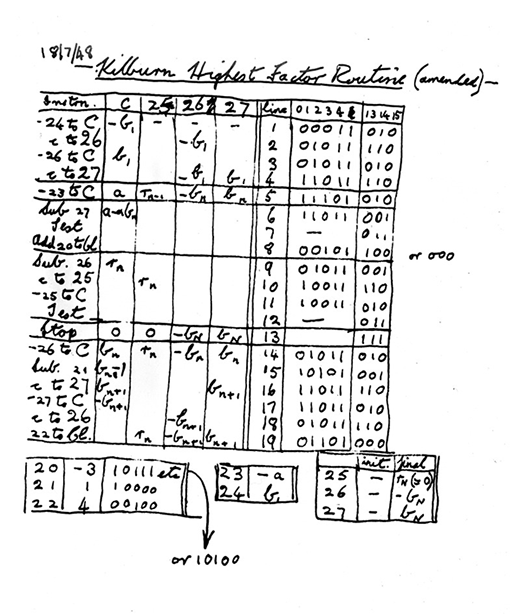
In the 1950s and '60s, source code was frequently provided for costless with software by the companies that created the programs. Equally growing computer companies expanded software's employ, source lawmaking became more prolific and sought after. Computing magazines prior to the net age would often print source lawmaking in their pages, with readers needing to retype the lawmaking character for character for their own apply. Later, floppy disks decreased the price for electronically sharing source code, and so the internet farther deleted these obstacles.
This was last updated in September 2019
Continue Reading About source code
- The value of running security analysis tools against source code
- Learn how various reckoner languages work
- How to properly use open source libraries
- How a source code strategy tin can assist with automating version control
Dig Deeper on Application development and blueprint
-

build

By: Katie Terrell Hanna
-

runtime

By: Ben Lutkevich
-

3 simple Java Hello Earth examples

By: Cameron McKenzie
-

Rust rises in popularity for deject-native apps and environments

By: Zachary Flower
Source: https://www.techtarget.com/searchapparchitecture/definition/source-code
0 Response to "If You Have a Piece of Code You Need to Use Again"
Post a Comment