Bullying When All Else Fails Try Again
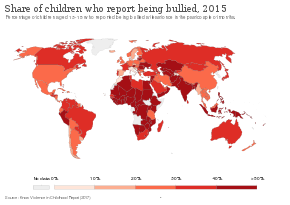
Share of children who study being bullied (2015)
Bullying is the utilize of force, coercion, hurtful teasing or threat, to abuse, aggressively dominate or intimidate. The beliefs is oft repeated and habitual. 1 essential prerequisite is the perception (past the cracking or past others) of an imbalance of physical or social power. This imbalance distinguishes bullying from conflict.[ane] Bullying is a subcategory of aggressive beliefs characterized by the following iii criteria: (i) hostile intent, (2) imbalance of ability, and (3) repetition over a period of time.[two] Bullying is the activeness of repeated, ambitious behavior intended to hurt another private, physically, mentally, or emotionally.
Bullying ranges from 1-on-ane, individual bullying through to group bullying, chosen mobbing, in which the nifty may have 1 or more "lieutenants" who are willing to assist the primary bully in their bullying activities. Bullying in school and the workplace is likewise referred to as "peer abuse".[3] Robert Westward. Fuller has analyzed bullying in the context of rankism. The Swedish-Norwegian researcher Dan Olweus says bullying occurs when a person is "exposed, repeatedly and over time, to negative actions on the part of ane or more other persons",[4] and that negative actions occur "when a person intentionally inflicts injury or discomfort upon another person, through physical contact, through words or in other ways".[4] Private bullying is commonly characterized by a person behaving in a certain way to gain power over another person.[5]
A bullying culture can develop in any context in which humans collaborate with each other. This may include schoolhouse, family, the workplace,[6] the home, and neighborhoods. The main platform for bullying in gimmicky culture is on social media websites.[seven] In a 2012 study of male adolescent American football players, "the strongest predictor [of bullying] was the perception of whether the most influential male in a thespian'southward life would corroborate of the bullying beliefs."[8] A study by The Lancet Kid & Adolescent Health in 2019 showed a relationship between social media use past girls and an increment in their exposure to bullying.[9]
Bullying may be divers in many different ways. In the United Kingdom, there is no legal definition of bullying,[ten] while some states in the U.s. have laws against it.[xi] Bullying is divided into 4 basic types of abuse – psychological (sometimes called emotional or relational), exact, concrete, and cyber.[12]
Behaviors used to assert such domination may include concrete assault or coercion, exact harassment, or threat, and such acts may be directed repeatedly toward particular targets. Rationalizations of such behavior sometimes include differences of social class, race, religion, gender, sexual orientation, appearance, behavior, trunk language, personality, reputation, lineage, strength, size, or power.[13] [xiv] [15] If bullying is washed by a group, it is called mobbing.[16]
Etymology
The discussion "bully" was first used in the 1530s meaning "sweetheart", applied to either sex activity, from the Dutch boel "lover, brother", probably diminutive of Eye High High german buole "brother", of uncertain origin (compare with the German buhle "lover"). The meaning deteriorated through the 17th century through "fine fellow", "blusterer", to "harasser of the weak". This may have been as a connecting sense betwixt "lover" and "ruffian" as in "protector of a prostitute", which was ane sense of "great" (though not specifically attested until 1706). The verb "to bully" is first attested in 1710.[17]
In the past, in American civilization, the term has been used differently, every bit an exclamation/exhortation, in particular famously associated with Theodore Roosevelt[18] and continuing to the present in the bully pulpit, Roosevelt'due south coining and also as faint/deprecating praise ("bully for him").
Types
Bullying has been classified past the body of literature into different types. These can be in the form of nonverbal, verbal, or physical beliefs. Another classification is based on perpetrators or the participants involved, then that the types include individual and collective bullying. Other interpretation also cite emotional and relational bullying in addition to physical harm inflicted towards another person or even property.[19] There is also the example of the more contempo phenomenon called cyberbullying.
Physical, verbal, and relational bullying are most prevalent in primary schoolhouse and could likewise begin much earlier while continuing into after stages in individuals lives.
Individual
Private bullying tactics are perpetrated by a single person confronting a victim or victims.[20] Individual bullying tin be classified into four types outlined below:[21]
Concrete
Physical bullying is any bullying that hurts someone's body or damages their possessions. Stealing, shoving, hitting, fighting, and intentionally destroying someone's property are types of physical bullying. Physical bullying is rarely the first form of bullying that a victim volition experience. Often bullying will brainstorm in a different course and later progress to physical violence. In concrete bullying the main weapon the dandy uses is his/her body, or some office thereof; or an object as a weapon when attacking his/her victim. Sometimes groups of young adults volition target and alienate a peer because of some adolescent prejudice. This tin can quickly lead to a state of affairs where they are being taunted, tortured, and "beaten up" past their classmates. Physical bullying will ofttimes escalate over time, and tin pb to a detrimental or fatal ending, and therefore many try to end information technology quickly to preclude any further escalation.[22]
Exact
Exact bullying is one of the most common types of bullying. This is whatsoever bullying that is conducted by speaking, other apply of the voice, or some course of trunk language and does not involve any physical contact. Bullying usually begins at this stage and includes whatever of the following:
- Derogatory name-calling and nicknaming
- Spreading rumors or lying almost someone
- Threatening someone
- Yelling at or talking to someone in a rude or unkind tone of voice, specially without justifiable cause
- Mocking someone'due south voice or fashion of speaking
- Laughing at someone
- Use of body language (i.e., the middle finger) to torture someone
- Making insults or otherwise making fun of someone
In exact bullying, the master weapon the bully uses is vox. In many cases, verbal bullying is common in both genders, but girls are more probable to perform it. Girls, in general, are more subtle with insults than boys. Girls use verbal bullying, as well as social exclusion techniques, to dominate and control other individuals and show their superiority and power, often to try to impress someone they idolize. Nevertheless, at that place are too many boys with subtlety enough to utilize verbal techniques for domination, and who are good in using words when they want to avoid the trouble that tin can come up with physically bullying someone else.[23]
Relational
Relational bullying (sometimes referred to equally social assailment) is the type of bullying that uses relationships to injure others.[24] The term also denotes any bullying that is washed with the intent to hurt somebody'southward reputation or social standing which can also link in with the techniques included in physical and verbal bullying. Relational bullying is a form of bullying common amongst youth, simply particularly upon girls. Social exclusion (slighting or making someone experience "left out") is one of the nigh common types of relational bullying. Relational bullying tin be used as a tool by bullies to both improve their social standing and control others. Unlike physical bullying which is obvious, relational bullying is not overt and can continue for a long time without existence noticed.[25]
Cyberbullying
Cyberbullying is the utilise of engineering science to harass, threaten, embarrass, or target another person. When an adult is involved, information technology may meet the definition of cyber-harassment or cyberstalking, a crime that can have legal consequences and involve jail fourth dimension.[26] This includes bullying by use of electronic mail, instant messaging, social media websites (such equally Facebook), text messages, and jail cell phones. It is stated that Cyberbullying is more common in secondary schoolhouse than in main school.[21]
Collective
Collective bullying tactics are employed by more than 1 individual against a victim or victims. Collective bullying is known as mobbing, and tin can include any of the individual types of bullying. Trolling behavior on social media, although mostly assumed to be individual in nature by the casual reader, is onetime organized efforts by sponsored astroturfers.
Mobbing
Mobbing refers to the bullying of an individual by a group, in any context, such as a family, peer group, schoolhouse, workplace, neighborhood, community, or online. When information technology occurs as emotional abuse in the workplace, such as "ganging up" by co-workers, subordinates or superiors, to force someone out of the workplace through rumor, allusion, intimidation, humiliation, discrediting, and isolation, it is also referred to every bit malicious, nonsexual, nonracial/racial, general harassment.[27]
Characteristics
Of bullies and accomplices
Studies accept shown that envy and resentment may be motives for bullying.[28] Enquiry on the self-esteem of bullies has produced equivocal results.[29] [xxx] While some bullies are arrogant and narcissistic,[31] they tin can also apply bullying equally a tool to conceal shame or anxiety or to boost self-esteem: by demeaning others, the abuser feels empowered.[32] Bullies may neat out of jealousy or because they themselves are bullied.[33] Psychologist Roy Baumeister asserts that people who are prone to abusive behavior tend to have inflated but frail egos. Because they think too highly of themselves, they are ofttimes offended past the criticisms and lack of deference of other people, and react to this disrespect with violence and insults.[34] [ total commendation needed ]
Researchers have identified other risk factors such as depression[35] and personality disorders,[36] every bit well every bit quickness to anger and use of strength, addiction to aggressive behaviors, mistaking others' actions as hostile, business organisation with preserving self-image, and engaging in obsessive or rigid deportment.[37] A combination of these factors may also be causes of this behavior.[38] In ane study of youth, a combination of antisocial traits and depression was found to be the best predictor of youth violence, whereas video game violence and television violence exposure were not predictive of these behaviors.[39]
Bullying may too event from a genetic predisposition or a brain abnormality in the bully.[40] While parents can aid a toddler develop emotional regulation and control to restrict aggressive behavior, some children fail to develop these skills due to insecure attachment with their families, ineffective subject, and environmental factors such equally a stressful abode life and hostile siblings.[21] Moreover, according to some researchers, bullies may be inclined toward negativity and perform poorly academically. Dr. Cook says, "A typical bully has trouble resolving problems with others and also has trouble academically. He or she usually has negative attitudes and beliefs about others, feels negatively toward himself/herself, comes from a family unit environment characterized past conflict and poor parenting, perceives schoolhouse as negative and is negatively influenced by peers."[41]
Contrarily, some researchers have suggested that some bullies are psychologically strongest and have high social continuing among their peers, while their targets are emotionally distressed and socially marginalized.[42] Peer groups oft promote the bully's actions, and members of these peer groups also engage in behaviors, such as mocking, excluding, punching, and insulting one another as a source of entertainment.[21] Other researchers also argued that a minority of the bullies, those who are not in-turn bullied, enjoy going to schoolhouse, and are least probable to have days off sick.[43]
Research indicates that adults who bully take authoritarian personalities, combined with a strong need to control or boss.[44] Information technology has also been suggested that a prejudicial view of subordinates can be a particularly strong hazard factor.[45]
In a recent written report, bullies showed lower school performance-related self-esteem than non-involved students. They likewise showed higher social self-esteem than victims of traditional bullying.[46]
Encephalon studies have shown that the section of the brain associated with reward becomes agile when bullies are shown a video of someone inflicting pain on another.[47]
Of typical bystanders
Oftentimes, bullying takes identify in the presence of a large group of relatively uninvolved bystanders. In many cases, it is the bully's ability to create the illusion they take the support of the majority present that instills the fear of "speaking out" in protestation of the bullying activities being observed by the grouping. Unless the "neat mentality" is effectively challenged in any given grouping in its early on stages, it often becomes an accepted, or supported, norm within the group.[48] [49]
Unless action is taken, a "culture of bullying" is often perpetuated within a group for months, years, or longer.[50]
Bystanders who have been able to establish their own "friendship group" or "back up group" have been found to be far more likely to opt to speak out against bullying beliefs than those who accept not.[51] [52]
In addition to communication of clear expectations that bystanders should intervene and increasing individual self-efficacy, there is growing research to propose interventions should build on the foundation that bullying is morally wrong.[53]
Among adults, being a bystander to workplace bullying was linked to depression.[54]
Of victims
Dr. Melt says, "A typical victim is likely to be ambitious, lack social skills, think negative thoughts, experience difficulties in solving social problems, come from a negative family, schoolhouse and community environments and be noticeably rejected and isolated past peers."[41] Victims often have characteristics such as being physically and mentally weak, as well as existence hands distraught emotionally. They may also have physical characteristics that make them easier targets for bullies such as being overweight or having some type of physical deformity. Boys are more than likely to exist victims of physical bullying while girls are more likely to be bullied indirectly.[55]
Low levels of cocky-esteem has been identified equally a frequent ancestor of bullying victimization. Victims of traditional bullying tend to have lower global, social, trunk-related, and emotional self-esteem compared to uninvolved students.[46] [56] [57] [58] [59] Victims of cyberbullying, on the other hand, may not have lower cocky-esteem scores than uninvolved students but might accept higher torso-related self-esteem than both victims of traditional bullying and bullies.[46]
The results of a meta-analysis conducted by Melt and published by the American Psychological Association in 2010 ended the main run a risk factors for children and adolescents being bullied, and also for condign bullies, are the lack of social trouble-solving skills.[41]
Children who are bullied oft testify concrete or emotional signs, such as: being agape to attend school, complaining of headaches or a loss of appetite, a lack of interest in school activities, spending fourth dimension with friends or family, reluctance to go out in public for fearfulness they may encounter their bullies in public places other than school, and having an overall sense of sadness.
Effects
Mona O'Moore of the Anti-Bullying Centre at Trinity College in Dublin, has written, "At that place is a growing trunk of enquiry which indicates that individuals, whether child or adult, who are persistently subjected to abusive behavior are at risk of stress related illness which tin sometimes pb to suicide"[threescore] Those who have been the targets of bullying tin can suffer from long term emotional and behavioral problems. Bullying can cause loneliness, low, anxiety, lead to low self-esteem and increased susceptibility to illness.[61] Bullying has likewise been shown to cause maladjustment in immature children, and targets of bullying who were as well bullies themselves exhibit even greater social difficulties.[46] [62] A mental health report too found that bullying was linked to eating disorders, feet, body dysmorphia and other negative psychological effects.[63] Both victims and perpetrators have been shown to exhibit higher levels of loneliness.[46]
Suicide
Even though at that place is evidence that bullying increases the gamble of suicide, bullying alone does not cause suicide. Depression is one of the main reasons why kids who are bullied die by suicide.[64] It is estimated that between 15 and 25 children dice by suicide every twelvemonth in the UK alone because they are existence bullied.[65] Certain groups seem to incur a higher risk for suicide, such as Native Americans, Alaskan Natives, Asian Americans, and LGBT people. When someone feels unsupported by family or friends, information technology tin make the situation much worse for the victim.[66]
In a self-report study completed in New York past 9th through 12th graders, victims of bullying reported more depressive symptoms and psychological distress than those who did not experience bullying.[67] All types of involvement in bullying among both boys and girls is associated with depression even a couple years later.[68] Another report that followed upwards with Finnish teens 2 years after the initial survey showed that low and suicidal ideation is college with teens who are bullied than those who did not study experiencing bullying.[68] A Dutch longitudinal study on uncomplicated students reported that boys who are neat-victims, who play both roles of a victim and a bully, were more than likely to experience depression or serious suicidal ideation than the other roles, victims or bullies only, while girls who accept any involvement in bullying have a higher level of chance for depression.[69] In a study of high school students completed in Boston, students who self reported being victims of bullying were more likely to consider suicide when compared to youth who did non study being bullied.[70] The aforementioned written report too showed a higher take chances of suicidal consideration in youth who report beingness a perpetrator, victim, or victim-perpetrator. Victims and victim-bullies are associated with a higher risk of suicide attempts. The identify where youth live also appears to differentiate their bullying experiences such that those living in more urban areas who reported both being bullied and bullying others announced to bear witness higher chance of suicidal ideation and suicide attempts.[70] A national survey given to American 6th through 10th grade students found that cyberbullying victims feel a higher level of low than victims experiencing other forms of bullying. This can be related to the anonymity behind social media.[71] If a teen is existence bullied and is displaying symptoms of depression information technology should exist questioned and interventions should be implemented.[68] The Danish study showed that kids who are bullied talked to their parents and teachers about it and some reported a decrease in bullying or a stop in the bullying later a teacher or parent intervened. The study emphasizes the importance of implementing programme-collaborations in schools to have programs and anti-bullying interventions in place to foreclose and properly arbitrate when it occurs.[69] The study also shows the importance of having parents and teachers talk to the bullies about their bullying behavior in gild to provide the necessary support for those experiencing bullying.[69]
While some people find it very easy to ignore a swell, others may find it very difficult and reach a breaking point. There have been cases of apparent bullying suicides that take been reported closely by the media. These include the deaths of Ryan Halligan, Phoebe Prince, Dawn-Marie Wesley, Nicola Ann Raphael, Megan Meier, Audrie Pott, Tyler Clementi, Jamey Rodemeyer, Kenneth Weishuhn, Jadin Bell, Kelly Yeomans, Rehtaeh Parsons, Amanda Todd, Brodie Panlock,[72] Jessica Haffer,[73] Hamed Nastoh,[74] Sladjana Vidovic,[75] Apr Himes,[76] Cherice Moralez[77] and Rebecca Ann Sedwick.[78] According to the suicide awareness voices for instruction, suicide is one of the leading causes of decease for youth from 15 to 24 years erstwhile. Over 16 percent of students seriously consider suicide, 13 percent create a plan, and 8 percent accept made a serious attempt.[79]
Positive development
Some have argued that bullying can teach life lessons and instill strength. Helene Guldberg, a child development academic, sparked controversy when she argued that existence a target of bullying tin teach a kid "how to manage disputes and boost their power to collaborate with others", and that teachers should not intervene but leave children to respond to the bullying themselves.[80]
The education of such anti-bullying coping skills to "would-exist-targets"[ failed verification ] and to others has been found to be an constructive long term means of reducing bullying incidence rates and a valuable skill-gear up for individuals.[81]
Hormonal
Statistically decision-making for historic period and pubertal status, results indicated that on boilerplate verbally bullied girls produced less testosterone, and verbally bullied boys produced more testosterone than their nonbullied counterparts.[82]
Nighttime triad
Research on the dark triad (narcissism, Machiavellianism, and psychopathy) indicate a correlation with bullying as role of evidence of the aversive nature of those traits.[83]
Projection
A bully may project his/her own feelings of vulnerability onto the target(southward) of the bullying action. Despite the fact that a swell's typically denigrating activities are aimed at the bully'southward targets, the true source of such negativity is ultimately most ever found in the peachy's own sense of personal insecurity and/or vulnerability.[84] Such aggressive projections of displaced negative emotions tin can occur anywhere from the micro-level of interpersonal relationships, all the mode upward through to the macro-level of international politics, or even international armed conflict.[85]
Emotional intelligence
Bullying is abusive social interaction between peers which tin can include assailment, harassment, and violence. Bullying is typically repetitive and enacted by those who are in a position of power over the victim. A growing body of research illustrates a significant relationship between bullying and emotional intelligence (EI). Mayer et al., (2008) defines the dimensions of overall EI every bit "accurately perceiving emotion, using emotions to facilitate thought, agreement emotion, and managing emotion".[86] The concept combines emotional and intellectual processes.[87] Lower emotional intelligence appears to be related to involvement in bullying, equally the bully and/or the victim of bullying. EI seems to play an important role in both bullying behavior and victimization in bullying; given that EI is illustrated to be malleable, EI pedagogy could greatly improve bullying prevention and intervention initiatives.[88]
Context
Cyberbullying
Cyberbullying is whatsoever bullying done through the utilize of engineering. This form of bullying tin can hands become undetected because of lack of parental/authoritative supervision. Because bullies can pose equally someone else, it is the virtually bearding form of bullying. Cyberbullying includes, but is not limited to, abuse using email, instant messaging, text messaging, websites, social networking sites, etc.[89] With the creation of social networks like Facebook, Myspace, Instagram, and Twitter, cyberbullying has increased. Particular watchdog organizations take been designed to comprise the spread of cyberbullying.[xc]
Disability bullying
It has been noted that disabled people are disproportionately affected by bullying and abuse, and such activity has been cited as a hate offense.[91] The bullying is not limited to those who are visibly disabled, such as wheelchair-users or physically plain-featured such equally those with a fissure lip, but also those with learning disabilities, such as autism[92] [93] and developmental coordination disorder.[94] [95]
At that place is an additional problem that those with learning disabilities are often not as able to explain things to other people, so are more likely to exist disbelieved or ignored if they practice mutter.[ citation needed ]
Gay bullying
Gay bullying and gay bashing designate direct or indirect verbal or physical actions by a person or group against someone who is gay or lesbian, or perceived to be and then due to rumors or because they are considered to fit gay stereotypes. Gay and lesbian youth are more likely than straight youth to report bullying, also equally be bullied.[96] [97]
Legal bullying
Legal bullying is the bringing of a vexatious legal action to control and punish a person. Legal bullying can oft take the form of frivolous, repetitive, or burdensome lawsuits brought to intimidate the accused into submitting to the litigant'southward asking, not because of the legal merit of the litigant's position, just principally due to the accused's inability to maintain the legal battle. This tin can also take the course of Strategic Lawsuit Against Public Participation (SLAPP). It was partially concern about the potential for this kind of abuse that helped to fuel the protests against SOPA and PIPA in the United States in 2011 and 2012.[ citation needed ]
Military bullying
In 2000, the UK Ministry building of Defence (MOD) defined bullying as "the use of concrete strength or the abuse of authorisation to intimidate or victimize others, or to give unlawful punishments".[98]
Some argue that this behaviour should be allowed, due to means in which "soldiering" is different from other occupations. Soldiers expected to gamble their lives should, according to them, develop strength of body and spirit to take bullying.[99]
Parental bullying of children
Parents who may displace their anger, insecurity, or a persistent need to dominate and control upon their children in excessive ways have been proven to increase the likelihood that their own children will in turn become overly ambitious or controlling towards their peers.[100] The American Psychological Clan advises on its website that parents who may doubtable their own children may exist engaging in bullying activities amongst their peers should carefully consider the examples which they themselves may be setting for their own children regarding how they typically interact with their ain peers, colleagues, and children.[101]
Prison bullying
The prison house environment is known for bullying. An additional complication is the staff and their relationships with the inmates. Thus, the following possible bullying scenarios are possible:
- Inmate bullies inmate (echoing school bullying)
- Staff bullies inmate
- Staff bullies staff (a manifestation of workplace bullying)
- Inmate bullies staff
School bullying (bullying of students in schools)

Bullying tin can occur in nearly whatsoever part in or effectually the school edifice, although it may occur more ofttimes during physical teaching classes and activities such as recess. Bullying also takes identify in school hallways, bathrooms, on school buses and while waiting for buses, and in classes that crave grouping work and/or after school activities. Bullying in schoolhouse sometimes consists of a group of students taking advantage of or isolating one student in particular and gaining the loyalty of bystanders who want to avoid condign the next target. In the 2011 documentary Great, nosotros run across first mitt the torture that kids go through both in school and while on the schoolhouse coach. As the moving picture follows effectually a few kids we see how bullying affects them both at school as well as in their homes. While bullying has no age limit, these bullies may taunt and tease their target before finally physically bullying them. Bystanders typically cull to either participate or picket, sometimes out of fear of becoming the next target.
Bullying can as well exist perpetrated by teachers and the schoolhouse organization itself; there is an inherent power differential in the system that can easily predispose to subtle or covert corruption (relational aggression or passive aggression), humiliation, or exclusion—even while maintaining overt commitments to anti-bullying policies.[102] [103] [104]
In 2016, in Canada, a Due north American legal precedent was set by a mother and her son, after the son was bullied in his public school. The mother and son won a court case against the Ottawa-Carleton Commune School Lath, making this the first case in N America where a school lath has been found negligent in a bullying example for declining to meet the standard of intendance (the "duty of care" that the school lath owes to its students). Thus, information technology sets a precedent of a school board being found liable in negligence for harm acquired to a child, because they failed to protect a child from the bullying deportment of other students. There has been simply one other similar bullying case and it was won in Commonwealth of australia in 2013 (Oyston v. St. Patricks College, 2013).[105]
Sexual bullying
Sexual bullying is "any bullying behaviour, whether physical or non-concrete, that is based on a person'southward sexuality or gender. Information technology is when sexuality or gender is used as a weapon by boys or girls towards other boys or girls – although it is more commonly directed at girls. It can be carried out to a person'south face, backside their back or through the apply of technology."[106]
Trans bullying
Trans bashing is the act of victimizing a person physically, sexually, or verbally considering they are transgender or transsexual.[107] Unlike gay bashing, it is committed considering of the target'due south actual or perceived gender identity, non sexual orientation.
Workplace bullying
Workplace bullying occurs when an employee experiences a persistent pattern of mistreatment from others in the workplace that causes damage.[108] Workplace bullying can include such tactics as verbal, nonverbal, psychological, physical abuse and humiliation. This blazon of workplace aggression is particularly difficult because, unlike the typical forms of school bullying, workplace bullies often operate within the established rules and policies of their organization and their society. Bullying in the workplace is in the bulk of cases reported as having been perpetrated by someone in authorization over the target. However, bullies tin also be peers, and occasionally tin be subordinates.[109]
The first known documented use of "workplace bullying" is in 1992 in a volume by Andrea Adams called Bullying at Work: How to Face up and Overcome Information technology.[110] [111]
Research has also investigated the impact of the larger organizational context on bullying as well as the group-level processes that impact on the incidence, and maintenance of bullying behavior.[112] Bullying can be covert or overt. It may exist missed by superiors or known past many throughout the organization. Negative effects are not limited to the targeted individuals, and may lead to a decline in employee morale and a change in organizational civilization.[vi] A Cochrane Collaboration systematic review has found very low quality evidence to propose that organizational and private interventions may forbid bullying behaviors in the workplace.[113]
In academia
Bullying in academia is workplace bullying of scholars and staff in academia, especially places of college educational activity such every bit colleges and universities. It is believed to exist common, although has not received as much attention from researchers as bullying in some other contexts.[114]
In bluish collar jobs
Bullying has been identified as prominent in bluish collar jobs, including on oil rigs and in mechanic shops and machine shops. It is thought that intimidation and fear of retribution cause decreased incident reports. In industry sectors dominated by males, typically of niggling education, where disclosure of incidents are seen every bit effeminate, reporting in the socioeconomic and cultural milieu of such industries would likely pb to a vicious circle. This is frequently used in combination with manipulation and coercion of facts to gain favour amidst higher-ranking administrators.[115]
In information technology
A civilisation of bullying is common in information technology (IT), leading to loftier sickness rates, low morale, poor productivity, and high staff-turnover.[116] Deadline-driven project work and stressed-out managers take their price on Information technology workers.[117]
In the legal profession
Bullying in the legal profession is believed to be more common than in some other professions. It is believed that its adversarial, hierarchical tradition contributes towards this.[118] Women, trainees and solicitors who take been qualified for five years or less are more than impacted, as are ethnic minority lawyers and lesbian, gay and bisexual lawyers.[119]
In medicine
Bullying in the medical profession is common, particularly of student or trainee doctors and of nurses. It is thought that this is at to the lowest degree in office an outcome of conservative traditional hierarchical structures and pedagogy methods in the medical profession, which may consequence in a bullying cycle.
In nursing
Even though The American Nurses Association believes that all nursing personnel have the correct to piece of work in safe, non-abusive environments, bullying has been identified as beingness particularly prevalent in the nursing profession although the reasons are not clear. It is idea that relational aggression (psychological aspects of bullying such equally gossiping and intimidation) are relevant. Relational assailment has been studied among girls but not so much among developed women.[117] [120]
In teaching
School teachers are commonly the subject of bullying just they are also sometimes the originators of bullying within a school environment.
In other areas
As the verb to not bad is defined as simply "forcing ane'south way aggressively or by intimidation", the term may generally employ to any life experience where ane is motivated primarily by intimidation instead of by more than positive goals, such as mutually shared interests and benefits. As such, any figure of authorization or power who may use intimidation every bit a master means of motivating others, such every bit a neighborhood "protection racket don", a national dictator, a babyhood band-leader, a terrorist, a terrorist organization, or even a ruthless concern CEO, could rightfully be referred to equally a not bad. According to psychologist Pauline Rennie-Peyton, nosotros each face the possibility of being bullied in any phase of our lives.[121]
Machines
Children have been observed bullying anthropomorphic robots designed to help the elderly. Their attacks first with blocking the robots' paths of motion and and so escalate to verbal abuse, hitting and destroying the object. Seventy-five percent of the kids interviewed perceived the robot as "human-similar" still decided to abuse it anyway, while 35% of the kids who beat up the robot did and so "for enjoyment".[122]
Prevention
Bullying prevention is the collective endeavour to prevent, reduce and stop bullying.[123] Many campaigns and events are designated to bullying prevention throughout the earth. Bullying prevention campaigns and events include: Anti-Bullying Day, Anti-Bullying Calendar week, International Day of Pink, International Stand to Bullying Day and National Bullying Prevention Month. Anti-Bullying laws in the U.S. take besides been enacted in 23 of its l states, making bullying in schools illegal.[124]
Responding to bullying
Bullying is typically ongoing and not isolated behaviour. Common means that people try to answer, are to try to ignore it, to confront the bullies or to turn to an authority figure to effort to address it.
Ignoring it often does nothing to stop the bullying continuing, and it can become worse over fourth dimension.[125] It can be important to address bullying behaviour early on on, as it can be easier to control the earlier it is detected.[126] Bystanders play an important role in responding to bullying, as doing aught tin can encourage it to continue, while modest steps that oppose the behaviour can reduce information technology.[127]
Authority figures can play an of import role, such as parents in kid or adolescent situations, or supervisors, human-resource staff or parent-bodies in workplace and volunteer settings. Dominance figures can be influential in recognising and stopping bullying behaviour, and creating an surroundings where it doesn't continue.[128] [129] In many situations however people acting every bit authority figures are untrained and unqualified, do non know how to respond, and tin can brand the situation worse.[130] In some cases the authority figures even back up the people doing the bullying, facilitating it standing and increasing the isolation and marginalising of the target.[131] Some of the most effective ways to respond, are to recognise that harmful behaviour is taking place, and creating an environment where it won't go on.[132] People who are existence targeted have little control over which authority figures they can turn to and how such matters would be addressed, however i ways of support is to find a counsellor or psychologist who is trained in handling bullying.
Come across likewise
- Abuse
- Abusive power and command
- Bashing (pejorative)
- Brodie'due south Police (act)
- Bully (2011 film)
- Bullying and suicide
- Bullying of students in higher education
- Bigotry
- Harassment
- Hate crime
- Hazing
- Mobbing
- Passive-aggressive behavior
- Psychological trauma
- Relational assailment
- Scapegoating
- Social dominance orientation
- Social exclusion
- Social media and suicide
- Social rejection
- Social undermining
- Taunting
- Teasing
- The Bully: A Word and Activity Story (book)
- Victimisation
- Workplace bullying
References
- ^ Juvonen, J.; Graham, South. (2014). "Bullying in Schools: The Power of Bullies and the Plight of Victims". Annual Review of Psychology. 65: 159–85. doi:10.1146/annurev-psych-010213-115030. PMID 23937767. S2CID 207640520.
- ^ Burger, Christoph; Strohmeier, Dagmar; Spröber, Nina; Bauman, Sheri; Rigby, Ken (2015). "How teachers reply to school bullying: An exam of cocky-reported intervention strategy utilise, moderator effects, and concurrent use of multiple strategies". Teaching and Instructor Educational activity. 51: 191–202. doi:10.1016/j.tate.2015.07.004.
- ^ Elizabeth Bennett (1 January 2006). Peer Abuse Know More!: Bullying from a Psychological Perspective. Infinity. ISBN978-0-7414-3265-0. Archived from the original on xiv September 2014. Retrieved 2013-10-29 .
- ^ a b "History". OLWEUS Bullying Prevention Programme. OLWEUS Bullying Prevention Program. Archived from the original on 2013-10-29. Retrieved 2013-ten-28 .
- ^ Valerie Eastward. Besag (1989). Bullies and victims in schools: a guide to understanding and direction. Open University Press. ISBN978-0-335-09542-ane. Archived from the original on 2014-07-07. Retrieved 2013-ten-29 .
- ^ a b Williams, Ray (iii May 2011). "The Silent Epidemic: Workplace Bullying". Psychology Today. Archived from the original on 2015-xi-21. Retrieved 2016-11-13 .
- ^ Whittaker, E (2016). "Cyberbullying via social media". Journal of School Violence: 11–29.
- ^ Steinfeldt, Jesse A.; Vaughan, Ellen L.; LaFollette, Julie R.; Steinfeldt, Matthew C. (October 2012). "Bullying among boyish football game players: Role of masculinity and moral temper". Psychology of Men and Masculinity. xiii (iv): 340–353. doi:x.1037/a0026645. hdl:2022/14023.
- ^ "Social Media Apply May Harm Teens' Mental Health Past Disrupting Positive Activities, Study Says". 2019-08-13.
- ^ "The Academy of Manchester Nobility at Work and Study Policy". The University of Manchester. January 2012. Archived from the original on 2013-10-29. Retrieved 2013-ten-28 .
- ^ "Country Laws Related to Bullying Among Children and Youth" (PDF). U.S. Department of Health and Man Services - Wellness Resources and Services Administration - Maternal and Child Wellness Bureau. U.South. Department of Health and Human Services. Archived from the original (PDF) on March four, 2011. Retrieved 2013-10-28 .
- ^ Brank, Eve Yard.; Hoetger, Lori A.; Hazen, Katherine P. (December 2012). "Bullying". Annual Review of Police force and Social Scientific discipline. viii (1): 213–230. doi:ten.1146/annurev-lawsocsci-102811-173820.
- ^ "Children who are bullying or being bullied". Cambridgeshire Canton Council: Children and families. Cambridgeshire County Council. 2013-07-24. Archived from the original on 2013-x-29. Retrieved 2013-10-28 .
- ^ Ericson, Nels (June 2001). "Addressing the Problem of Juvenile Bullying" (PDF). OJJDP Fact Sheet #FS-200127. 27. Archived (PDF) from the original on 2015-06-26. Retrieved 2013-10-28 .
- ^ Meyer, Doug (2016). "The Gentle Neoliberalism of Modern Anti-bullying Texts: Surveillance, Intervention, and Bystanders in Contemporary Bullying Discourse". Sexuality Research and Social Policy. 13 (4): 356–370. doi:10.1007/s13178-016-0238-9. S2CID 148471672.
- ^ Noa Davenport; Ruth Distler Schwartz; Gail Pursell Elliott (1999-07-01). Mobbing: Emotional Corruption in the American Workplace. Civil Order Publishing. ISBN978-0-9671803-0-iv. Archived from the original on 2014-01-01. Retrieved 2013-ten-28 .
- ^ "peachy". Online Etymology Lexicon. Douglas Harper. Archived from the original on 2013-x-29. Retrieved 2013-10-28 .
- ^ TR Correspondence 27 September 1907 Archived xvi Apr 2016 at the Wayback Auto "bully for you" in the positive sense
- ^ McGrath, Mary Jo (2007). School Bullying: Tools for Fugitive Harm and Liability. Thousand Oaks, CA: Corwin Press. p. 6. ISBN978-1-4129-1571-7.
- ^ "Bullying Definitions". Archived from the original on 2016-03-04. Retrieved 2016-02-26 .
- ^ a b c d Berger, Kathleen Stassen (2014). Invitation to the Life Span. New York: Worth Publishers. ISBN978-1464172052.
- ^ "no bullying". nobullying.com/physical-bullying/. Archived from the original on one December 2016. Retrieved 30 November 2016.
- ^ "What is Verbal Bullying and How to Handle Verbal Bullies - Bullying Statistics". Bullying Statistics. 2015-07-08. Archived from the original on 2016-11-25. Retrieved 2016-11-30 .
- ^ Breakstone, Steve; Dreiblatt, Michael; Dreiblatt, Karen (2009). How to End Bullying and Social Aggression: Elementary Grade Lessons and Activities That Teach Empathy, Friendship, and Respect. Thousand Oaks, CA: Corwin Press. p. nine. ISBN978-ane-4129-5810-iii.
- ^ Norton, Chris. "What is the Definition of Relational Bullying / Social Bullying - Brim Anti-Bullying Software". BRIM Anti-Bullying Software. Archived from the original on 2016-12-01. Retrieved 2016-11-thirty .
- ^ "Cyberbullying". kidshealth.org. Archived from the original on 2016-12-01. Retrieved 2016-11-thirty .
- ^ Mobbing: Emotional Abuse in the American Workplace by Noa Davenport, Ruth D. Schwartz and Gail Pursell Elliott.
- ^ Ståle Einarsen (2003). Bullying and Emotional Abuse in the Workplace: International Perspectives in Enquiry and Practice. Taylor & Francis. ISBN978-0-415-25359-8. Archived from the original on 2014-01-02. Retrieved 2013-10-29 .
- ^ Cardemil, Alisha R.; Cardemil, Esteban V.; O'Donnell, Ellen H. (August 2010). "Self-Esteem in Pure Bullies and Bully/Victims: A Longitudinal Analysis". Journal of Interpersonal Violence. 25 (eight): 1489–1502. doi:ten.1177/0886260509354579. PMID 20040706. S2CID 26698674.
- ^ Batsche, George M.; Knoff, Howard M. (1994). "Bullies and their victims: Understanding a pervasive problem in the schools". School Psychology Review. 23 (2): 165–175. doi:10.1080/02796015.1994.12085704. Archived from the original on 2012-03-02.
- ^ "Those who tin can, do. Those who can't, bully". Bully OnLine. Tim Field. Archived from the original on 2013-07-07. Retrieved 2013-ten-28 .
- ^ Syiasha. "Presentation Bullying". Scribd. Scribd Inc. Archived from the original on 2013-x-29. Retrieved 2013-x-28 .
- ^ Levinson, Edward M.; Levinson, Edward M. (2004). "Assessment of Bullying: A Review of Methods and Instruments". Periodical of Counseling & Development. 82 (iv): 496–503. doi:10.1002/j.1556-6678.2004.tb00338.ten.
- ^ Roy Baumeister. Evil: Inside Human Violence and Cruelty
- ^ Patterson M (December 2005). "The bully as victim?". Paediatric Nursing. 17 (x): 27–30. doi:10.7748/paed2005.12.17.x.27.c981. PMID 16372706. S2CID 34334649.
- ^ Kumpulainen, 1000. (2008). "Psychiatric conditions associated with bullying". International Journal of Adolescent Medicine and Health. 20 (2): 121–132. doi:10.1515/ijamh.2008.20.2.121. PMID 18714551. S2CID 32858078.
- ^ Hazlerr, R. J.; Carney, J. 5.; Dark-green, S.; Powell, R.; Jolly, L. S. (1997). "Areas of Expert Agreement on Identification of Schoolhouse Bullies and Victims". School Psychology International. xviii (i): 5–14. doi:10.1177/0143034397181001. S2CID 144789919.
- ^ Craig, W.M. (1998). "The human relationship amidst bullying, victimization, depression, feet, and aggression in elementary schoolhouse children". Personality and Private Differences. 24 (ane): 123–130. doi:x.1016/S0191-8869(97)00145-i.
- ^ Ferguson, Christopher J. (2011). "Video Games and Youth Violence: A Prospective Analysis in Adolescents" (PDF). Journal of Youth and Boyhood. xl (iv): 377–91. doi:x.1007/s10964-010-9610-x. PMID 21161351. S2CID 207206722. Archived from the original (PDF) on 2012-05-25.
- ^ Brawl, H.A. (Jan 2008). "Genetic and environmental influences on victims, bullies and bully-victims in childhood". Journal of Child Psychology and Psychiatry. 49 (1): 104–12. doi:10.1111/j.1469-7610.2007.01821.x. PMID 18181884.
- ^ a b c Cook, Clayton R.; Williams, Kirk R.; Guerra, Nancy 1000.; Kim, Tia E.; Sadek, Shelly (2010). "Predictors of Bullying and Victimization in Childhood and Adolescence: A Meta-analytic Investigation" (PDF). School Psychology Quarterly. 25 (ii): 65–83. CiteSeerXx.ane.1.617.7810. doi:10.1037/a0020149. Archived (PDF) from the original on 2014-03-07. Retrieved 2013-10-28 .
- ^ Juvonen (2003) Bullying Among Young Adolescents: The Stiff, the Weak and the Troubled Archived 2011-08-18 at the Wayback Machine in Pediatrics, Dec 2003, "The benefits of bullying". 2004. Archived from the original on 2011-09-28. Retrieved 2011-09-03 .
- ^ "Bullies are the healthiest pupils". Didactics. BBC News. BBC. 1999-12-xiv. Archived from the original on 2013-10-30. Retrieved 2013-10-29 .
- ^ Carroll K. Brodsky (1976). The Harassed Worker. Lexington Books. ISBN978-0-669-01041-1. Archived from the original on 2014-07-08. Retrieved 2013-10-29 .
- ^ Ashforth, Blake (1994). "Picayune Tyranny in Organizations". Homo Relations. 47 (7): 755–778. doi:10.1177/001872679404700701. S2CID 145699243.
- ^ a b c d due east Burger, C.; Bachmann, L. (2021). "Perpetration and victimization in offline and cyber contexts: A variable- and person-oriented test of associations and differences regarding domain-specific self-esteem and school adjustment". Int J Environ Res Public Health. 18 (19): 10429. doi:x.3390/ijerph181910429. PMC8508291. PMID 34639731.
- ^ "Bullying tendency wired in brain". 2008-11-07. Retrieved 2020-03-30 .
- ^ "Bullies, Victims, and Bystanders". athealth.com: Consumer: Problems. Athealth.com. Archived from the original on 2014-03-05. Retrieved 2013-ten-29 .
- ^ "New Tactics To Tackle Eyewitness's Role In Bullying". Scientific discipline News. Science Daily. Science Daily, LLC. 2009-01-27. Archived from the original on 2013-x-29. Retrieved 2013-10-29 .
- ^ "419: Petty Tyrant". This American Life: Radio Archive. Chicago Public Media & Ira Drinking glass. 2010-11-12. Archived from the original on 2013-x-10. Retrieved 2013-10-29 .
- ^ "Pasco students get 'hero' training to stop bullying". Pasco County. The Tampa Tribune. Tampa Media Group, LLC. 2010-ten-12. Archived from the original on 2014-05-02. Retrieved 2013-ten-29 .
- ^ "Program Helps Students Combat Bullying - Students participate with enthusiasm". Winning Harmony Counselling. 2010-x-04. Archived from the original on 2013-05-xiii. Retrieved 2013-ten-29 .
- ^ Thornberg, Robert; Tenenbaum, Laura; Varjas, Kris; Meyers, Joel; Jungert, Tomas; Vanegas, Gina (Baronial 2012). "Bystander Motivation in Bullying Incidents: To Arbitrate or Not to Intervene?". Western Periodical of Emergency Medicine. 13 (three): 247–252. doi:10.5811/westjem.2012.3.11792. PMC3415829. PMID 22900122.
- ^ Jensen, I. B.; Alipour, A.; Hagberg, J.; Jensen, I. B. (August 2013). "The bear on of bystanding to workplace bullying on symptoms of depression among women and men in industry in Sweden: an empirical and theoretical longitudinal study". International Archives of Occupational and Environmental Health. 86 (6): 709–716. doi:ten.1007/s00420-012-0813-1. ISSN 1432-1246. PMC3722445. PMID 22940902.
- ^ Vanderbilt, Douglas; Augustyn, Marilyn (2010). "The effects of bullying". Paediatrics and Child Health. 20 (7): 315–320. doi:10.1016/j.paed.2010.03.008.
- ^ Andreou E. (2000). <49::Aid-AB4>three.0.CO;2-Chiliad "Bully/victim problems and their association with psychological constructs in 8-to 12-twelvemonth-old Greek schoolchildren". Aggressive Beliefs. 26 (1): 49–56. doi:10.1002/(SICI)1098-2337(2000)26:one<49::Assistance-AB4>iii.0.CO;2-M.
- ^ Austin South.; Joseph Southward. (1996). "Cess of dandy/victim issues in 8 to 11 year-olds". British Periodical of Educational Psychology. 66 (4): 447–456. doi:x.1111/j.2044-8279.1996.tb01211.ten. PMID 9008423.
- ^ Callaghan Due south.; Joseph S. (1995). "Self-concept and peer victimization amidst schoolchildren". Personality and Individual Differences. eighteen (one): 161–163. doi:10.1016/0191-8869(94)00127-E.
- ^ Neary A.; Joseph S. (1994). "Peer victimization and its relationship to self-concept and depression amid schoolgirls". Personality and Private Differences. sixteen (1): 183–186. doi:10.1016/0191-8869(94)90122-8.
- ^ "Anti-Bullying Centre". Trinity College Dublin. Archived from the original on 2013-eleven-25. Retrieved 2013-ten-28 .
- ^ Kipling D. Williams; Joseph P. Forgas; William Von Hippel (13 May 2013). The Social Outcast: Ostracism, Social Exclusion, Rejection, and Bullying. Psychology Press. pp. 2–. ISBN978-1-135-42338-iv. Archived from the original on 3 January 2014. Retrieved 2013-10-29 .
- ^ Arsenault, Louise PhD; Walsh, Elizabeth; Trzesniewski, Kali; et al. (July 2006). "Bullying Victimization Uniquely Contributes to Aligning Problems in Young Children: A Nationally Representative Cohort Written report". Pediatrics. 118 (one): 130–138. doi:x.1542/peds.2005-2388. ISSN 0031-4005. PMID 16818558. S2CID 28961503.
- ^ "UK Mental Health Study". Brandwatch. Brandwatch, Ditch the Label.
- ^ Kim YS; Leventhal B (2008). "Bullying and suicide. A review". International Periodical of Adolescent Medicine and Wellness. xx (2): 133–54. doi:x.1515/IJAMH.2008.20.2.133. PMID 18714552. S2CID 41651943.
- ^ Statistics on bullying Archived February 17, 2005, at the Wayback Machine
- ^ Furnishings of Bullying | StopBullying.gov Archived 2015-11-twenty at the Wayback Car
- ^ BRUNSTEIN KLOMEK, ANAT; MARROCCO, FRANK; KLEINMAN, MARJORIE; SCHONFELD, IRVIN South.; GOULD, MADELYN Southward. (January 2007). "Bullying, Low, and Suicidality in Adolescents". Journal of the American Academy of Kid & Adolescent Psychiatry. 46 (one): 40–49. doi:10.1097/01.chi.0000242237.84925.18. ISSN 0890-8567. PMID 17195728.
- ^ a b c Kaltiala-Heino, Riittakerttu; Fröjd, Sari; Marttunen, Mauri (2009-07-09). "Involvement in bullying and depression in a ii-yr follow-up in middle adolescence". European Child & Adolescent Psychiatry. 19 (i): 45–55. doi:ten.1007/s00787-009-0039-two. ISSN 1018-8827. PMID 19588185. S2CID 23077909.
- ^ a b c Fekkes, M.; Pijpers, F. I. M.; Verloove-Vanhorick, Southward. P. (2005-02-01). "Bullying: who does what, when and where? Involvement of children, teachers and parents in bullying behavior". Health Educational activity Research. twenty (1): 81–91. doi:ten.1093/her/cyg100. ISSN 0268-1153. PMID 15253993.
- ^ a b Hepburn, Lisa; Azrael, Deborah; Molnar, Beth; Miller, Matthew (July 2012). "Bullying and Suicidal Behaviors Amidst Urban High School Youth". Journal of Adolescent Wellness. 51 (i): 93–95. doi:10.1016/j.jadohealth.2011.12.014. ISSN 1054-139X. PMID 22727083.
- ^ Wang, Jing; Nansel, Tonja R.; Iannotti, Ronald J. (April 2011). "Cyber and Traditional Bullying: Differential Association With Low". Journal of Adolescent Health. 48 (4): 415–417. doi:10.1016/j.jadohealth.2010.07.012. ISSN 1054-139X. PMC3058261. PMID 21402273.
- ^ "Men who tormented suicide waitress Brodie Panlock fined". Daily Telegraph. 2010-02-08. Retrieved xiv August 2017.
- ^ "Jessica Kassandra Haffer". Keith & Jeralyn Haffer. Archived from the original on 2014-01-04. Retrieved 2013-x-28 .
- ^ "Hamed Nastoh". Archived from the original on 2013-10-29. Retrieved 2013-10-28 .
- ^ Grzegorek, Vince (2010-08-23). "Family of Sladjana Vidovic, xvi-Year-Old Who Committed Suicide, Suing Mentor Schools". Retrieved 2018-01-29 .
- ^ Caruso, Kevin. "Apr Himes Memorial". Suicide.org. Suicide.org. Archived from the original on 2012-12-27. Retrieved 2013-10-28 .
- ^ McLaughlin, Elliot C. (2013-08-30). "Montana teen loved pit bulls, poetry before rape and suicide". U.South. CNN. Cable News Network. Archived from the original on 2013-10-17. Retrieved 2013-10-29 .
- ^ Pearce, Matt (2013-09-12). "Florida girl, 12, constitute dead subsequently bullies said 'kill yourself'". U.S.: Nation Now. Los Angeles Times. Archived from the original on 2013-10-30. Retrieved 2013-10-29 .
- ^ "bullying suicide statistics". Archived from the original on 2018-03-15. Retrieved 2019-02-06 .
- ^ Tanya (2009-02-02). "Child Development Academician Says Bullying Is Beneficial To Kids". News. Med India. Medindia. Archived from the original on 2013-xi-01. Retrieved 2013-10-29 .
- ^ Positive Anti-Bullying Strategies by Melissa Graham Archived 2013-11-10 at the Wayback Machine
- ^ Vaillancourt, T (2009). "Androgen dynamics in the context of children's peer relations: an exam of the links between testosterone and peer victimization". Aggressive Behavior. 35 (ane): 103–13. doi:ten.1002/ab.20288. PMID 19021234.
- ^ Chabrol H.; Van Leeuwen North.; Rodgers R.; Séjourné S. (2009). "Contributions of psychopathic, narcissistic, Machiavellian, and sadistic personality traits to juvenile delinquency". Personality and Individual Differences. 47 (7): 734–39. doi:10.1016/j.paid.2009.06.020.
- ^ Paul Gilbert, Overcoming Depression (1999) p.185–vi
- ^ Carl G. Jung ed., Man and his Symbols (London 1978) p.181–2
- ^ Mayer, J.D.; Roberts, R.D; Barasade, Southward.Grand. (2008). "Human abilities: Emotional intelligence". Annual Review of Psychology. 59 (one): 507–536. doi:10.1146/annurev.psych.59.103006.093646. PMID 17937602.
- ^ Tolegenova, A.A.; Jakupov, S.K.; Chung, Man Cheung; Saduova, Due south.; Jakupov, Grand.S. (2012). "A Theoretical Germination of Emotional Intelligence and Childhood Trauma among Adolescents". Procedia - Social and Behavioral Sciences. 69: 1891–1894. doi:10.1016/j.sbspro.2012.12.142.
- ^ Mckenna, J.; Webb, J. (2013). "Emotional intelligence". British Journal of Occupational Therapy. 76 (12): 560. doi:x.1177/030802261307601202. S2CID 208741104.
- ^ Jose Bolton; Stan Graeve (2005). No Room for Bullies: From the Classroom to Net . Boys Town Press. ISBN978-1-889322-67-4 . Retrieved 2013-10-29 .
- ^ Luxton, DD; June, JD; Fairall, JM (2012). "Social media and suicide: a public health perspective". Am J Public Health. 102 Suppl 2: S195–200. doi:10.2105/AJPH.2011.300608. PMC3477910. PMID 22401525.
- ^ Katherine Quarmby (2011). Scapegoat: Why We Are Failing Disabled People. Portobello Books Limited. ISBN978-1-84627-321-6. Archived from the original on 2014-01-01. Retrieved 2013-10-29 .
- ^ Clare Sainsbury (xxx September 2009). Martian in the Playground: Agreement the Schoolchild with Asperger's Syndrome. SAGE Publications. ISBN978-1-4462-4398-v. Archived from the original on ane January 2014. Retrieved 2013-10-29 .
- ^ Tony Attwood (2006). The Complete Guide to Asperger'south Syndrome . Jessica Kingsley Publishers. pp. 95–111. ISBN978-1-84310-495-vii . Retrieved 2013-10-29 .
- ^ Amanda Kirby (1 Oct 2002). Dyspraxia: The Hidden Handicap. Souvenir Press. pp. 106–113. ISBN978-0-285-63512-viii. Archived from the original on ane January 2014. Retrieved 2013-ten-29 .
- ^ Geoff Brookes (January 2005). Dyspraxia. Continuum. pp. 43–46. ISBN978-0-8264-7581-7. Archived from the original on 2014-01-01. Retrieved 2013-10-29 .
- ^ Berlan, Elise D.; Corliss, Heather Fifty.; Field, Alison E.; Goodman, Elizabeth; Austin, S. Bryn (2010-01-28). "Sexual Orientation and Bullying Among Adolescents in the Growing Upward Today Written report". Journal of Boyish Health. 46 (four): 366–371. doi:10.1016/j.jadohealth.2009.10.015. PMC2844864. PMID 20307826. Retrieved 2013-10-28 .
- ^ Meyer, Doug (2017). "The Disregarding of Heteronormativity: Emphasizing a Happy Queer Adulthood and Localizing Anti-Queer Violence to Adolescent Schools". Sexuality Research & Social Policy. fourteen (three): 331–344. doi:10.1007/s13178-016-0272-7. S2CID 151482192.
- ^ Dannatt, Sir Richard (2008). "Lawful: Paragraph xx" (PDF). Values and Standards of the British Army. the British Regular army. Archived from the original (PDF) on 2013-08-17. Retrieved 2013-10-29 .
- ^ Jean M. Callaghan; Franz Kernic (2003). "Chapter 2: "Social Psychology" of the Individual Soldier". Armed services and International Security: Global Trends and Bug. LIT Verlag Münster. pp. 19–. ISBN978-3-8258-7227-4. Archived from the original on 2014-01-01. Retrieved 2013-ten-29 .
- ^ Priesnitz, Wendy. "Parental Bullying Creates Bullies". Natural Kid Mag. Wendy Priesnitz. Archived from the original on 2013-10-31. Retrieved 2013-10-29 .
- ^ "Bullying: How parents, teachers, and kids tin take activeness to prevent bullying". American Psychological Association. American Psychological Clan. Retrieved 2013-10-29 .
- ^ James Garbarino; Ellen deLara (2 September 2003). And Words Can Hurt Forever: How to Protect Adolescents from Bullying, Harassment, and Emotional Violence . Complimentary Printing. ISBN978-0-7432-2899-ii . Retrieved 2013-10-29 .
- ^ Witted, Kathryn Suzanne (2005), "Pupil Reports of Physical and Psychological Maltreatment in Schools: An Under Explored Aspect of Student Victimization in Schools", PhD dissertation, Academy of Tennessee, archived from the original on 2013-10-31, retrieved 2013-ten-29
- ^ Whitted, K. S.; Dupper, D. R. (2007). "Practise Teachers Great Students?: Findings From a Survey of Students in an Alternative Didactics Setting". Education and Urban Society. xl (3): 329–341. doi:x.1177/0013124507304487. S2CID 143894407.
- ^ "Ottawa News | Latest Information, Updates & Manufactures | Ottawa Citizen". Archived from the original on 2017-02-10. Retrieved 2016-07-22 .
- ^ "The NSPCC working definition of Sexual Bullying" (PDF). NSPCC. Archived (PDF) from the original on xx Dec 2016. Retrieved 13 September 2016.
- ^ Guilty plea over transsexual bashing Archived 2008-05-02 at the Wayback Machine Past Mariza O'Keefe in Herald Sunday
- ^ Rayner, C. & Keashley, Fifty. (2005). Bullying at work: A perspective from Britain and Due north America. In Due south. Fox & P. E. Spector (eds.) Counterproductive work behavior: Investigations of actors and targets (pp. 271-296). Washington DC: American Psychological Association.
- ^ Rayner, C., & Cooper, C. L. (2006). Workplace Bullying. In Kelloway, East., Barling, J. & Hurrell Jr., J. (eds.), Handbook of workplace violence (pp. 47-90). Thousand Oaks, CA: Sage.
- ^ Google ngrams
- ^ Adams, Andrea with contributions from Crawford, Neil Bullying at Work: How to Confront and Overcome It (1992)
- ^ Ramsay, South., Troth, A & Branch, South. (2010). Work-place bullying: A grouping processes framework Journal of Occupational and Organizational Psychology, 84(4), 799-816.
- ^ Gillen, Patricia A; Sinclair, Marlene; Kernohan, Due west George; Begley, Cecily Grand; Luyben, Ans G (2017-01-xxx). "Interventions for prevention of bullying in the workplace". Cochrane Database of Systematic Reviews. 1: CD009778. doi:10.1002/14651858.cd009778.pub2. PMC6464940. PMID 28134445.
- ^ Keashly, Loraleigh; Neuman, Joel H. (2010). "Faculty Experiences with Bullying in Higher Education - Causes, Consequences, and Management" (PDF). Administrative Theory & Praxis. 32 (1): 48–seventy. doi:ten.2753/ATP1084-1806320103. S2CID 142766958. Archived (PDF) from the original on 2013-10-31. Retrieved 2013-10-29 .
- ^ Notelaers, Guy; Vermunt, Jeroen One thousand.; Baillien, Elfi; Einarsen, Ståle; De Witte, Hans (2011). "Exploring Risk Groups Workplace Bullying with Categorical Data". Industrial Health. 49 (1): 73–88. doi:10.2486/indhealth.ms1155. PMID 20823631. Archived from the original on 2012-04-25. Retrieved 2013-10-29 .
- ^ Thomson, Rebecca. "IT profession fated by bullying". ComputerWeekly.com: Feature. TechTarget. Archived from the original on 2013-x-29. Retrieved 2013-ten-29 .
- ^ a b Ann Richards; Sharon L. Edwards (2008). A Nurse's Survival Guide to the Ward. Churchill Livingstone. ISBN978-0-443-06897-three. Archived from the original on 2014-01-01. Retrieved 2013-10-29 .
- ^ Le Mire, Suzanne; Owens, Rosemary A propitious moment?: Workplace bullying and regulation of the legal profession University of New S Wales Police Journal, The Book 37 Event 3 (Dec 2014) Archived 2015-02-01 at the Wayback Auto
- ^ Society publishes guidance on tackling bullying in solicitor profession Archived 2015-02-01 at the Wayback Machine The Journal of the Constabulary Gild of Scotland 27 June 2011
- ^ "Violence, Incivility, & Bullying". American Nurses Association. Retrieved 21 April 2022. ; Dellasega, Cheryl A. (2009). "Bullying Among Nurses". American Journal of Nursing. 109 (1): 52–58. doi:10.1097/01.NAJ.0000344039.11651.08. PMID 19112267.
- ^ Karim, Nadiya (2010-01-15). "Bullying in Universities: It exists". News: Education: Higher. The Independent. Archived from the original on 2013-12-16. Retrieved 2013-ten-29 .
- ^ "Scientists are teaching robots to avert children — considering kids can exist surprisingly mean". Business organisation Insider . Retrieved 2017-11-02 .
- ^ National Academies of Sciences, Engineering, and Medicine (2016). Rivara, Frederick; Suzanne, Le Menestrel (eds.). Preventing Bullying Through Science, Policy, and Practice. National Academies Printing. doi:10.17226/23482. ISBN978-0-309-44067-7. PMID 27748087. Archived from the original on 2016-05-xviii.
{{cite volume}}: CS1 maint: uses authors parameter (link)
- ^ Ross, SW; Horner, RH (2009). "Bully prevention in positive behavior back up". Journal of Applied Behavior Assay. 42 (four): 747–59. doi:ten.1901/jaba.2009.42-747. PMC2791686. PMID 20514181.
- ^ W. Craig et al., "Responding to bullying, what works"
- ^ W. Ci, "What tin be done to stop bullying among children? Testify from Canada"
- ^ Bang-up-zero Commonwealth of australia Foundation, "Respond to bullying" Archived 2018-05-26 at the Wayback Machine
- ^ "Stop bullying on the spot"
- ^ Prophylactic work Australia, "Guide for preventing and responding to workplace bullying"
- ^ Veronica Birkett, "Bullied? Don't tell the instructor"
- ^ "Responding to bullying in Arc UNSW sports"
- ^ E. Field, "The prevalence of workplace bullying in Australia"
Farther reading
- Kohut MR The Consummate Guide to Understanding, Controlling, and Stopping Bullies & Bullying: A Complete Guide for Teachers & Parents (2007)
- Bullies and Victims in Schools: a guide to agreement and management by Valerie E. Besag (1989)
- The Fight That Never Ends by Tim Brown
- Odd Girl Out: The Hidden Culture of Aggression in Girls" by Rachel Simmons ISBN 0-15-602734-eight
- Bullycide, Death at Playtime by Neil Marr and Tim Field ISBN 0-9529121-two-0
- Bullycide in America: Moms Speak Out most the Bullying/Suicide Connectedness – by Brenda Loftier, Bullycide.org
- A Journey Out of Bullying: From Despair to Promise by Patricia L. Scott
- "Peer Abuse Know More! Bullying From A Psychological Perspective" By Elizabeth Bennett
- New Perspectives on Bullying by Ken Rigby
- Garbarino, J. & de Lara, E. (2003). And Words Can Injure Forever: How to Protect Adolescents from Bullying, Harassment, and Emotional Violence. Archived 2011-09-27 at the Wayback Machine The Free Press: New York NY.
- Joanne Scaglione, Arrica Rose Scaglione Bully-proofing children: a practical, hands-on guide to stop bullying 2006
- Why Is Everybody E'er Picking on Me: A Guide to Treatment Bullies for Young People. past Terrence Webster-Doyle. Volume and Teaching curriculum.
- "Why Nerds are Unpopular", by Paul Graham. This essay is an example of how even medium differences, in a hierarchical, nil-sum, or negative environments, can lead to ostracism or persecution.
- Lord of the Flies by William Golding (1954). A famous work describing how a group of schoolboys trapped on an island descends into savagery.
External links
- Bullying at Curlie
- Citizens Advice in the U.k.
- Bullying. No Way! (Australian Education Government)
- Bullying in schools (UK – schools)
- PBSKids.org "Great Books About Bullies"
- Be Brave Against Bullying, a UFT project
- U.S. Department of Education's Education Resources Data Center (ERIC)
- Smashing Online
Source: https://en.wikipedia.org/wiki/Bullying
0 Response to "Bullying When All Else Fails Try Again"
Post a Comment